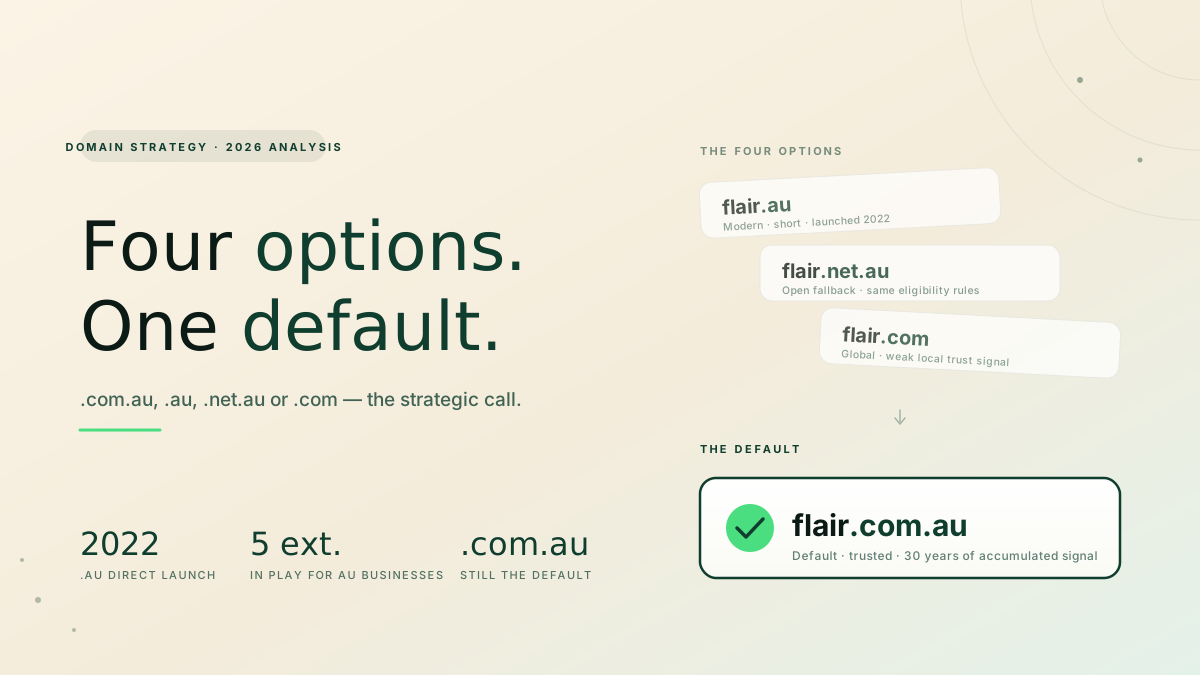
The 2022 reshuffle in one diagram
Four dates frame everything that has happened in the .au namespace since. Two were registry events, one was a product launch, and the last is the residual state the launch left behind. Read them in order before reading anything else.
Three things matter. The launch on 24 March 2022 was the first time a registerable .au direct name existed. The priority window let existing .com.au, .net.au and .org.au holders claim the matching direct version before the public could touch it. And the residual contested-name overhang means a meaningful share of the most valuable .au inventory in 2026 is locked — not available at any price.
Who won the .au direct launch
Three classes of business captured almost all of the value the launch created.
Existing .com.au holders who claimed defensively. The simplest win went to anyone who already held the matching .com.au and remembered to claim the .au direct during the priority window. One extra annual fee, brand locked down on both extensions, no broker and no premium. Those paired registrations would cost five-figure sums to assemble on the open market today. Anyone who held a .com.au before 4 February 2022 and lodged the priority application got the cleanest deal of the decade.
Short-brand startups that timed it well. New consumer brands launching in 2022 and 2023 — direct-to-consumer products, app companies, design-led startups — registered short, clean .au direct names without the brutal acquisition cost their .com.au equivalents would have demanded. A four-letter brandable .au that would have been impossible on .com.au at any reasonable price was, in some cases, available at hand-registration cost. The early movers built logos and brand systems around the shorter form before the trust gap had time to feel like a constraint.
Portfolio investors who bid intelligently on dropped names. The third group is less visible but equally real. Investors who understood the Priority Allocation Process spent the window mapping which names would drop out of contests or release at general availability. By 3 October 2022, the most attentive had registered hundreds of short .au direct names now licensed or resold at premium-tier prices on marketplaces including the Flair secondary market. Today's standing inventory of premium .au direct names is largely a product of those early portfolio plays.
What unites all three winners is timing. Each had a position to defend or a thesis worth acting on inside a six-month window. The window closed in 2022 and does not reopen.
Who lost, and why it still matters
Three corresponding losses are still shaping the 2026 market.
Founders who didn't claim during the priority window. Plenty of Australian businesses simply didn't know the priority process existed. Registrar notification emails landed in spam, owners were busy, the deadline came and went. By 3 October 2022, the matching .au direct version of their .com.au was either registered to a portfolio investor or held in an unresolved contest. The defensive move that would have cost twenty dollars at the time now costs whatever the current holder is willing to part with — typically four or five figures for any name with brand value.
Businesses still locked in unresolved priority hold contests. Where two or more eligible parties applied for the same .au direct name during the priority window, the name went into priority hold and stayed there. Each applicant must renew their priority application annually each 20 September. Names where two large established holders both refused to back down are still locked in 2026 — not registerable by anyone, not transferable, not usable. Some of these contests will resolve through attrition over the next several renewal cycles. Others will sit indefinitely. The auDA Priority Allocation Process page explains the mechanism in detail.
Brands that registered .au without securing the matching .com.au. The third loss is self-inflicted. New businesses launched on a short .au direct registration in 2022 or 2023 without acquiring the matching .com.au — some deliberately, betting the trust gap would close quickly, others by oversight. Either way, the matching .com.au still claims a meaningful share of recall traffic, and any visitor who types it by reflex lands on a competitor, a parked page, or nothing at all. Recovering it usually means brokering with the current holder, and the price compounds with how recognisable the brand has become.
The 2026 extension landscape
What the launch settled, four years on:
.com.au is the same default it always was, but the meaning has shifted slightly. Holding it now signals not just an Australian business, but one whose owners were either established before 2022 (and almost certainly hold the matching .au direct) or built their position post-launch on the secondary market. Acquisition cost for any commercially useful .com.au has climbed because portfolio investors are now buying both extensions as a paired asset, which has thinned the pool of singles available cheaply.
.au direct sits in a more interesting position than the trust-gap framing suggests. Adoption has climbed steadily but unevenly — strong in tech, design, and modern consumer brands, much slower in traditional services. The shorter form has the visual edge for any brand whose name is short enough that the extension is a meaningful share of the visible product. The catch is that the most valuable .au inventory either belongs to a paired .com.au holder or is locked in a residual priority contest.
.com behaves the same way it always has. The 2022 launch had no effect on global .com pricing or availability. What did change is the relative attractiveness of the local alternatives — the .au direct option means that businesses no longer have to choose between the long-form .com.au and the global .com as their only two short-name options.
.net.au has lost some of its fallback value because .au direct is now usually the more attractive backup when the matching .com.au is unavailable. It still works, but the case for it has narrowed.
.org.au is unchanged in both function and audience — the not-for-profit and community-organisation lane.
| Extension | What 2022 launch did to it | Who it makes sense for now | Realistic acquisition cost in 2026 |
|---|---|---|---|
.com.au |
Pulled into paired-asset pricing with .au direct | Established Australian businesses, local services | $10–$25/yr hand-reg · $1k–$500k+ secondary |
.au direct |
Created the namespace; left a contested-name overhang | Short brandables, design-led consumer products | $10–$25/yr hand-reg · $500–$50k+ secondary |
.com |
Unchanged; relative position softened against .au | Globally-ambitious SaaS, international brands | $15–$30/yr hand-reg · $1k–$1M+ secondary |
.net.au |
Lost most of its fallback value to .au direct | Niche fallback when .com.au and .au both gone | $10–$25/yr · low secondary demand |
.org.au |
Unaffected | Not-for-profits, charities, community groups | $10–$25/yr |
The strategic call: three scenarios, three answers
Three buyer scenarios cover almost every Australian extension decision being made in 2026. The right answer is different for each.
Scenario 1 — The local services business. A plumber, dentist, accountant, or trades operator serving a specific Australian geography. Customers expect .com.au; trust signal matters; SEO is dominated by local-intent queries. .com.au is the right primary, no exceptions. If the matching .au direct is available, claim it defensively for $15–$20 a year; if it's not, ignore it — the trust signal of the .com.au is doing all the work, and .au direct adoption among the over-45 customer demographic is too thin to justify any acquisition spend.
Scenario 2 — The short-name startup. A consumer brand, design-led product, or app launching in 2026 where the brand name is four to six letters and the visual identity will live on packaging, app icons, and a homepage that's photographed for press. .au direct is the right primary, paired with the matching .com.au defensively. The brevity advantage is real and durable; the trust gap has narrowed enough that the cost of the .com.au defensive registration covers the residual risk. If the matching .com.au is held by someone else, this is the most common reason to engage a broker in 2026.
Scenario 3 — The globally-ambitious SaaS. Australian-headquartered, but the addressable market is global from day one. .com is the right primary, and the spend required to acquire one is part of the cost of doing business at that ambition level. The Australian extensions become defensive — register .com.au and .au direct so a future Australian competitor can't intercept local search traffic, but anchor brand identity on the .com. The pillar guide on choosing a domain name for an Australian business covers when this acquisition spend is justified — the practical rule is "less than three months of projected marketing spend, almost always worth it".
Scenario 3 is also where the .com.au vs .com question gets its sharpest edge. Pre-launch, the choice was binary and tilted heavily toward .com.au for any Australian primary; post-2022, the .au direct option absorbs some of the pressure but doesn't change the .com.au vs .com calculation for global plays. The local trust signal of .com.au is real but unrecoverable for international audiences; the global recall of .com is real but acquisition costs sit at five-to-six figures for any commercially useful name. The table below summarises where each one wins.
| Question | .com.au |
.com |
|---|---|---|
| Best for | Australian businesses serving Australian customers | Globally-ambitious SaaS, multi-country brands |
| Australian SEO advantage | Strong — treated as a local signal by default | Weak unless geotargeting is configured manually |
| Typical 2026 acquisition cost (quality brandable) | $1k–$50k+ on the secondary market | $10k–$250k+ — almost all need brokered acquisition |
The same logic, abstracted into a flowchart for readers who prefer to see the decision tree:
What to do if you're still on the wrong side of the 2022 reshuffle
If your business is in one of the loser categories above, three concrete moves are open.
Chase a contested name out of hold. Where the .au direct version of your .com.au is in priority-hold contest with another eligible party, the legal path forward is either negotiation with the other applicant or attrition — the contest resolves when only one party renews. Track the 20 September annual renewal cycle. If the other applicant lapses, the name resolves to you at the next renewal. If they don't, sometimes a structured offer to drop their application — paid as a one-time fee — will move things faster than waiting another decade for organic attrition.
Broker the matching .au or .com.au from the current holder. Where the missing extension is held by a third party — investor, dormant business, defensive holder — the realistic path is brokered acquisition. Reaching the holder directly almost never works; either no response, or an inflated quote to a buyer who has just signalled how badly they want it. Flair's broker team handles anonymous outreach, valuation against comparable sales, and escrow. Realistic acquisition costs vary by name quality, but most paired-extension buy-ins resolve in the low-five-figure range.
Restructure the brand to fit what's available. This is the option founders resist most and discover later they should have considered earlier. If both the matching .com.au and the .au direct are unrecoverable at acceptable cost, a small brand-name change at six months in is dramatically cheaper than living with the wrong infrastructure for a decade. Flair's broker team runs structured renaming engagements specifically for this case — when the original name is workable but the namespace position is not. Eligibility rules and the underlying naming-test framework are covered in the pillar guide; this article assumes them rather than repeating them.
Frequently asked questions
Why are some .au direct names still locked in 2026?
What are the main Australian domain extensions?
.com.au (commercial businesses, the Australian default), .au direct (the shorter form launched in 2022), .net.au (originally for network operators, now open to any ABN-holder under the same eligibility rules as .com.au), and .org.au (reserved by convention for not-for-profits and community organisations). .com is also commonly used by Australian businesses with global ambitions, but it's a generic global TLD rather than part of the Australian namespace.Is buying a .au direct cheaper than buying the matching .com.au?
.com.au equivalent, because demand has not yet caught up with the .com.au's three decades of established trust signal. The exception is short brandable names where the .au direct is the primary asset because of brevity — for those, the .au direct can trade above the matching .com.au.What happens to my .au direct if the .com.au holder challenges my registration?
.com.au holder believes they were entitled to claim it via the priority window, they can lodge a complaint with auDA. Genuinely valid priority claims that were missed during the window are rare four years on, but where the .com.au holder can demonstrate eligibility predating 4 February 2022 and a procedural failure in the priority process, complaints can succeed.Did portfolio investors really capture significant .au direct inventory at the launch?
How do I find out if a .au direct I want is in a priority-hold contest?
If I own the .com.au but missed the priority window for .au direct, is the .au gone forever?
Has the trust gap between .com.au and .au direct narrowed since 2022?
Closing thoughts
The 2022 reshuffle is the single event that explains most of what looks counterintuitive about the 2026 namespace — why some short .au names are unaffordable, why some .com.au and .au pairs trade as a single asset, why some businesses launched on .au-only and now regret it. Knowing which side of that reshuffle a name happens to sit on tells you more about the right call than any generic trust-signal framework can.
Need help choosing or acquiring a domain? Browse curated premium .com.au and .au domains at Flair, or speak with a Flair broker about acquiring a specific domain you have in mind. Free 24-hour appraisals available on any domain.