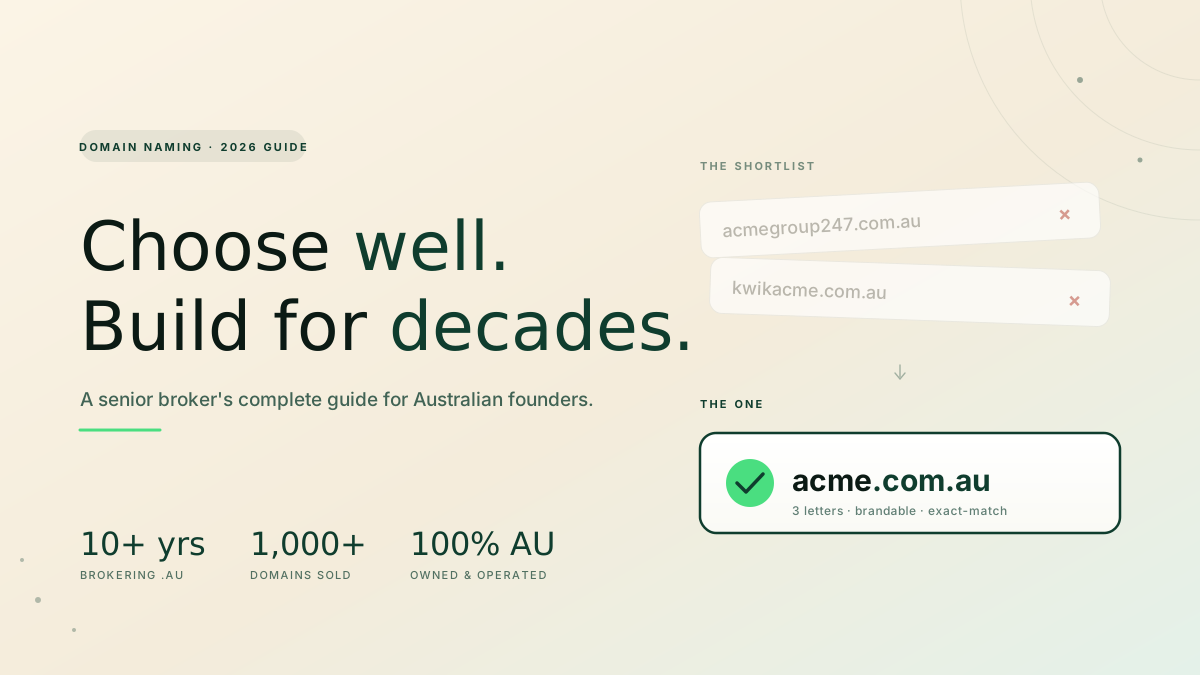
What makes a good business domain name
A strong business domain name does five things at once:
- Tells a customer who you are at first glance, without needing a tagline to explain it
- Is easy to say, spell and remember — no asking "is that with a hyphen?" on a sales call
- Survives growth so you're not rebranding in three years when you expand beyond your founding niche
- Earns trust on first impression because the extension and structure look like a real business
- Stays out of legal trouble — no trademark conflicts, no clashes with existing ASIC business names
Most domain decisions go wrong because the founder optimises for one of these and ignores the others. A keyword-stuffed name might rank in Google but sound generic. A clever brandable might be memorable but unspellable on the phone. The strongest domains satisfy all five tests at once.
The discipline this guide teaches is how to evaluate any candidate domain against all five dimensions before you buy.
.com.au, .au, .net.au or .com — choosing the right extension
For an Australian business, the extension you choose sends a signal about who you serve and how established you are. The four relevant options:
.com.au is the default for Australian businesses serving Australian customers. It signals legitimacy (you have an ABN, you're in Australia, you can be held accountable here). For 90% of Australian businesses, .com.au is the right choice. It's been the established extension for decades, customers trust it instinctively, and Australian search results favour it for local intent queries.
.au is the newer, shorter extension launched in 2022 by auDA. It's shorter and cleaner — flair.au reads more modern than flair.com.au. But adoption is still climbing, and many Australian customers default to typing .com.au regardless of what's on your business card. As of 2026, .au works well as a secondary or future-facing extension, but most businesses still anchor their primary identity on .com.au.
.net.au is the practical fallback when your preferred .com.au is already taken and you don't want to compromise on length or hyphens. Originally intended for network and infrastructure businesses, it's been open to any ABN-holder for years under the same eligibility rules as .com.au. Trust signal is weaker — most Australian customers expect to type .com.au by default — but a clean, short .net.au reads better than a padded "GroupStudio" workaround on .com.au. Worth considering when the exact match on .com.au isn't available and you're not prepared to pay for it on the secondary market.
.com signals you're a global business or aspire to be one. Tech startups, SaaS products, and businesses with international ambitions often choose .com over .com.au. The trade-off: Australian customers may not immediately recognise you as a local business, which can hurt trust for service businesses where "local" matters.
The practical default for most Australian businesses: register .com.au as primary, secure .au as a defensive registration, fall back to .net.au if the right .com.au is genuinely out of reach, and only chase .com if you have genuinely global ambitions and the budget to acquire it (which is usually significant for any decent name).
A note on .org.au — still available, but reserved by convention for not-for-profits, community organisations, charities, and member associations. Choose it if your entity fits that profile; avoid it for commercial businesses where it sends a misleading signal.
Quick reference for Australian businesses comparing extensions:
| Extension | Best for | Trust signal | Cost (typical) |
|---|---|---|---|
.com.au |
Australian businesses serving Australian customers | Strong — established default | $10–$25/year (hand-reg) up to $500k+ premium |
.au |
Modern Australian businesses, secondary registrations | Growing — newer, shorter | $10–$25/year (hand-reg) up to $50k+ premium |
.net.au |
Fallback when .com.au is taken |
Adequate — still a clear .au signal | $10–$25/year (hand-reg) up to ~$10k premium |
.org.au |
Not-for-profits & community organisations | Strong for NFPs, misleading otherwise | $10–$25/year |
.com |
Global businesses, tech startups, SaaS | Strong global, weak local | $15–$30/year (hand-reg) up to $1M+ premium |
The Australian naming rules you can't ignore
Australian domain registration has eligibility rules that don't apply to .com domains. Most founders don't realise this until they're rejected at registration.
To register a .com.au domain, you need one of:
- An active Australian Business Number (ABN)
- An Australian Company Number (ACN)
- A registered Australian business name
- An Australian trade mark (registered or pending)
- Status as an Australian citizen with a noted purpose
You also need the domain name itself to have a clear connection to your business. The connection can be:
- An exact or close match to your registered business or company name
- A match to your trademark
- A match to a product or service you offer
- An acronym of your business name
For .au direct domains (introduced in 2022), the rules are slightly more flexible — Australian residency or business presence is enough — but the broad framework is similar.
The practical implication: you cannot register a .com.au domain "on spec" without an Australian business connection. If you're planning a new business, you'll typically register the ABN or business name first, then the domain. If you're buying an existing premium .com.au from a marketplace like Flair, the transfer process handles the eligibility — but you still need to meet the Australian presence requirement to take ownership.
Eight tests every domain name should pass
Before registering or buying any domain, run it through these eight tests. A strong candidate passes at least six. A premium candidate passes all eight.
1. The radio test. Say the domain out loud. If a customer hears it once on a radio ad or podcast, can they spell it correctly without seeing it written down? Avoid silent letters, ambiguous homophones, and combinations that require explanation.
2. The voicemail test. Leave yourself a voicemail saying "go to [your domain] to learn more." Listen back. If you find yourself second-guessing what you said, customers will too.
3. The autocorrect test. Type the domain on a phone. Does autocorrect try to "fix" it into something else? If yes, expect lost traffic forever.
4. The trademark test. Search IP Australia's trademark register for your candidate name. Conflicts in the same class as your business are a hard stop — you'll be defending a trademark dispute within months. Conflicts in unrelated classes are usually fine but should be checked carefully.
5. The ASIC test. Search ASIC's business names register. Registered business names that are too similar to your candidate domain can cause legal and commercial conflict.
6. The Google test. Search the candidate name in Google. What comes up? If the first page is dominated by a powerful existing brand, you'll spend years fighting their SEO ranking. If results are sparse, the name is cleaner.
7. The future-proofing test. Where will your business be in five years? A domain that perfectly describes what you do today might be wrong when you expand. "SydneyDentalImplants.com.au" is fine for one Sydney clinic — it's a problem if you expand to Melbourne or beyond dentistry.
8. The international test. Read the domain in another language or accent. Does it carry unintended meaning? This matters for any business with international customers, suppliers, or staff.
Domains that fail two or more of these tests aren't necessarily disqualified — but you should be eyes-open about the trade-off you're accepting.
Common mistakes that cost businesses customers
Eight mistakes we see repeatedly in the Australian domain market:
Hyphenated domains. joes-plumbing-sydney.com.au looks like spam to most customers. Hyphenated domains never feel established and are almost never owned by serious businesses. Avoid them unless you have no choice.
Domains over 15 characters. Long domains are harder to type, harder to remember, and harder to fit on a business card. Aim for under 15 characters before the .com.au.
Numbers in domains. 247plumbing.com.au looks cheap. plumber24seven.com.au is worse. Numbers create ambiguity ("was it a digit or the word?") and rarely feel premium.
Generic geographic prefixes. australianbestplumbing.com.au and sydneyplumbingpro.com.au are forgettable because every competitor uses the same pattern. They also rank poorly because Google now recognises them as low-quality patterns. The exception is a clean geographic exact-match for a term real people actually search — sydneydentist.com.au gets ~450 searches per month at time of writing, and a domain that is the query gives you both a memorable handle and a permanent ranking edge for that exact phrase. The difference is genuine search demand for the unmodified "[city] + [service]" phrase, not stacked filler words like "best" or "pro".
Misspellings of established words. "Kwik" instead of "Quick", "Kleen" instead of "Clean". These felt clever in 1990. In 2026 they signal a discount brand and create persistent confusion.
Domains that need explanation. If you have to spell your domain on every phone call, you've chosen the wrong domain. The cost over 10 years of business is enormous.
Trademark conflicts. Building a brand on a domain that conflicts with an existing trademark in your industry is the single most expensive mistake possible. We've seen businesses spend $50,000+ in legal fees defending the right to keep operating before finally rebranding anyway.
Not securing variations. Once you have your primary domain, register the common misspellings, the .au version, and the singular/plural variant. The cost is less than $25 each per year. The cost of a competitor or squatter registering them later is far higher.
What to do when your first choice is taken
Almost every founder discovers that their first-choice domain is taken. The single best .com.au names were registered in the early 2000s and most of the second-best in the 2010s. In 2026, the available pool is thin.
You have five options when your preferred domain is taken:
Option 1: Add a qualifier. Add an industry word, a location, or a descriptor. "Acme.com.au" taken? Try "AcmeStudio.com.au" or "AcmeGroup.com.au". This is the path most ASIC name rejections push founders toward — usable, but the domain is now compromised on length and clarity.
Option 2: Use a different extension. If acme.com.au is taken, check acme.au, acme.net.au, and possibly acme.io or acme.co. None of these is as strong as the .com.au for an Australian business, but acme.au is increasingly acceptable in 2026 and the gap narrows every year.
Option 3: Choose a brandable alternative. Some of the best-known global brands aren't dictionary words — Atlassian, Canva, Xero. A made-up brandable can be just as strong as a dictionary word and is far easier to acquire as a new domain. The trade-off is that you'll need to invest in marketing to teach customers what you do.
Option 4: Try to buy the existing domain. Most .com.au domains held by individuals or non-trading businesses are theoretically for sale at the right price. Reaching the owner is the hard part — many owners don't respond to direct enquiries, or quote unrealistic prices to people who appear unsophisticated. This is what domain brokers exist for. A broker can identify the owner, approach anonymously, and negotiate a realistic price. Expect to pay anywhere from a few thousand to tens of thousands of dollars for a strong dictionary .com.au, plus the broker's commission (typically 15%).
Option 5: Buy a premium domain from the secondary market. Australian premium domains are listed for sale on marketplaces like Flair, Afternic, Sedo or Above. Prices range from a few hundred dollars for decent brandables up to hundreds of thousands for ultra-premium one-word .com.au names. The advantage over Option 4 is speed and certainty — you can see the price, decide, and transact within days rather than months.
For most founders, the realistic answer is some combination of Options 3 and 5: define what makes a strong brand for your business, then either choose a brandable you can hand register or browse the curated secondary market for established names that fit.
Should you buy a premium domain?
A premium domain — typically a short, dictionary-word .com.au, a strong brandable, or a very short abbreviation (2-, 3-, or 4-letter .com.au domains like nab.com.au or acmi.com.au) — costs anywhere from a few thousand dollars to over $200,000. The shortest abbreviations are the rarest tier of all: there are only 676 possible two-letter .com.au combinations, and almost every commercially useful one was registered years ago. For most founders the headline price seems like an enormous amount to pay for "just a domain." The honest answer is that for some businesses it's worth it many times over, and for others it's overspending on vanity.
The case for paying for a premium domain rests on three things:
Acquisition cost reduction. A strong, memorable domain reduces what you have to spend on Google Ads, brand-building, and PR over the life of the business. If a premium .com.au saves you 5% on customer acquisition costs over ten years, the maths is straightforward for any business spending meaningfully on marketing.
Trust and conversion uplift. Customers convert more readily on websites with credible domains. A serious-feeling .com.au lifts conversion versus a hyphenated or compromised alternative. The exact uplift varies, but for any business with meaningful transaction values, even small percentage gains pay for the domain quickly.
Asset value. A premium .com.au is a real asset that you own and that holds or grows in value — unlike marketing spend, which vanishes the moment you spend it. A $20,000 Google Ads campaign is gone in weeks; a $20,000 domain is still on the balance sheet ten years later, still earning brand recognition every time someone sees it on an invoice, business card, or email signature. Many businesses that sold for high multiples got there partly because the brand was anchored on a defensible domain that buyers couldn't easily replicate.
The case against:
Premium domains don't fix weak businesses. If your product, marketing, and operations are weak, the domain won't save you. The domain pays off when stacked on top of strong fundamentals — it doesn't substitute for them.
Diminishing returns at the top. The jump from a $500 hand-registration to a $5,000 premium is enormous. The jump from a $50,000 premium to a $250,000 ultra-premium is much smaller in marketing terms. Pay for what your business will actually leverage.
Cash flow tightness. For early-stage businesses, spending $20,000 on a domain when that money could go to product development or first hires is often the wrong call. Many successful Australian businesses launched on compromised domains and only upgraded later when cash flow allowed.
A practical rule: if a premium domain costs less than three months of your projected marketing spend, it's almost always worth paying for. If it costs more than twelve months of marketing spend, defer until you can justify it on revenue grounds.
How much should you actually pay?
The Australian domain market has roughly four price tiers in 2026:
Hand-registered new domains: $10–$25 per year. Direct from your registrar. This is what you pay for any available .com.au or .au no-one's registered yet.
Drop-catch and aftermarket: $25–$5,000. Domains that have recently expired or are being released. Quality varies enormously — some excellent names appear in drop catches, most don't. Flair's broker team can hunt and secure specific drop-catch targets for you, so you don't have to monitor expiry queues or fight registrar bots for a name yourself.
Standard premium: $1,000–$15,000. Decent brandables, three-letter combinations, and short keyword domains. Available from marketplaces like Flair, Afternic, Sedo or Above. This is where most premium Australian domains sit.
Ultra-premium: $15,000–$500,000+. One-word dictionary .com.au (like organic.com.au or era.com.au), short two-letter combinations, and category-killer keywords. These rarely come to market and command real money when they do.
If you're paying broker fees on an acquisition (where the domain isn't already listed for sale), add 15% on top of whatever price is negotiated, plus typically a $295 retainer.
Australian domain price tiers at a glance:
| Tier | Price range | What you get | Examples |
|---|---|---|---|
| Hand-registered | $10–$25/year | Any available .com.au, .au or .net.au domain | Brand new, never registered, or previously expired |
| Drop-catch / aftermarket | $25–$5,000 one-off | Recently expired or released domains | Variable quality |
| Standard premium | $1,000–$15,000 one-off | Decent brandables, 3-letter, short keyword domains | Most premium .com.au sales sit here |
| Ultra-premium | $15,000–$500,000+ one-off | One-word dictionary, 2-letter, category-killer | organic.com.au, era.com.au tier |
The naming process step-by-step
A disciplined naming process takes 4–8 weeks for most businesses. Rushing it is a leading cause of regret.
Week 1: Brainstorm. Generate 10–15 candidate names without filtering. Mix dictionary words, brandables, descriptive phrases, and made-up words. Don't check availability yet — that constraint kills creativity at the wrong stage. Aim for variety, not volume; a tight shortlist you'll actually evaluate beats a sprawling list you'll abandon.
Week 2: Filter to a shortlist of 5–7. Apply the eight tests from earlier in this guide to your Week 1 list. Cut anything that fails more than two tests; you should land on five to seven names worth taking into Week 3.
Week 3: Check availability. For each name on the shortlist, check .com.au, .au, and .com availability. Check ASIC business names and ASIC company names. Check IP Australia trademarks in your business class.
Week 4: Validate with real customers. Show the surviving 3–5 names to people who match your target customer profile. Don't ask "which do you like?" — ask "what kind of business do you think this is?" Names where the answer differs from your intent are usually wrong.
Week 5: Buy or acquire. Register hand-registerable names immediately. For taken premium names you want, start the acquisition conversation through a broker.
Week 6: Lock in the surroundings. Once you've chosen, register the variations (singular/plural, common misspellings, alternative extensions), reserve social handles, and file the trademark if you're going to.
Weeks 7–8: Set up email and operations. Configure DNS, set up business email on Microsoft 365 or Google Workspace, and update your ASIC business name to reflect the chosen brand.
When to bring in a broker or naming consultant
A domain broker or naming consultant earns their fee when one of these is true:
The domain you want is taken. A broker can identify the owner, approach anonymously, and negotiate the price. Without a broker, you'll typically either get no response, an inflated price, or both. Brokers also handle the escrow and transfer process so you don't lose money to a fraudulent seller.
You can't agree internally on a name. A naming consultant brings external perspective and process to break naming deadlocks within founding teams or boards.
The decision is high-stakes. For businesses with significant capital, brand investment, or growth ambitions, paying $1,500–$5,000 for a structured naming engagement is cheap insurance against a five-year regret.
You don't have time. Most founders underestimate how much focused time a proper naming process takes. If you have $500,000 of capital to deploy and you're trying to choose a name in spare hours, you're optimising the wrong constraint. Outsource the process.
Flair's brokerage team handles both domain acquisitions (helping you buy a domain owned by someone else) and naming engagements (helping you choose from scratch). Free initial consultations are available for either path.
Frequently asked questions
Can I register a .com.au domain without an ABN?
What's the cheapest place to register a .com.au domain?
Do I need to register both .com.au and .au?
How long does it take to buy a premium domain in Australia?
What happens if my preferred domain is already taken?
Should I buy a .com or stick with .com.au for an Australian business?
How do I check if a domain name is trademarked?
Closing thoughts
Choosing the right domain is one of the few decisions that compounds for decades. Spend longer on it than feels comfortable. Apply the eight tests. Resist the urge to settle for something you'll quietly regret. The right name — registered today or brokered through the secondary market — pays for itself many times over the life of the business.
Need help choosing or acquiring a domain? Browse curated premium .com.au domains at Flair, or speak with a Flair broker about acquiring a specific domain you have in mind. Free 24-hour appraisals available on any domain.